Currencies, Exchange & the Weight of Promise
A road-broker's record of nine currency systems of the Sundered Age. Not a scholarly treatise. A working record — the kind kept so the next crossing goes more smoothly than the last.
Compiled by Dorn Calder, Road-Broker, Valdenmoor. With annotations by Sable Dunmore, Breck Ironhallow, Thessaly Vorn, and Mara Ashbone.
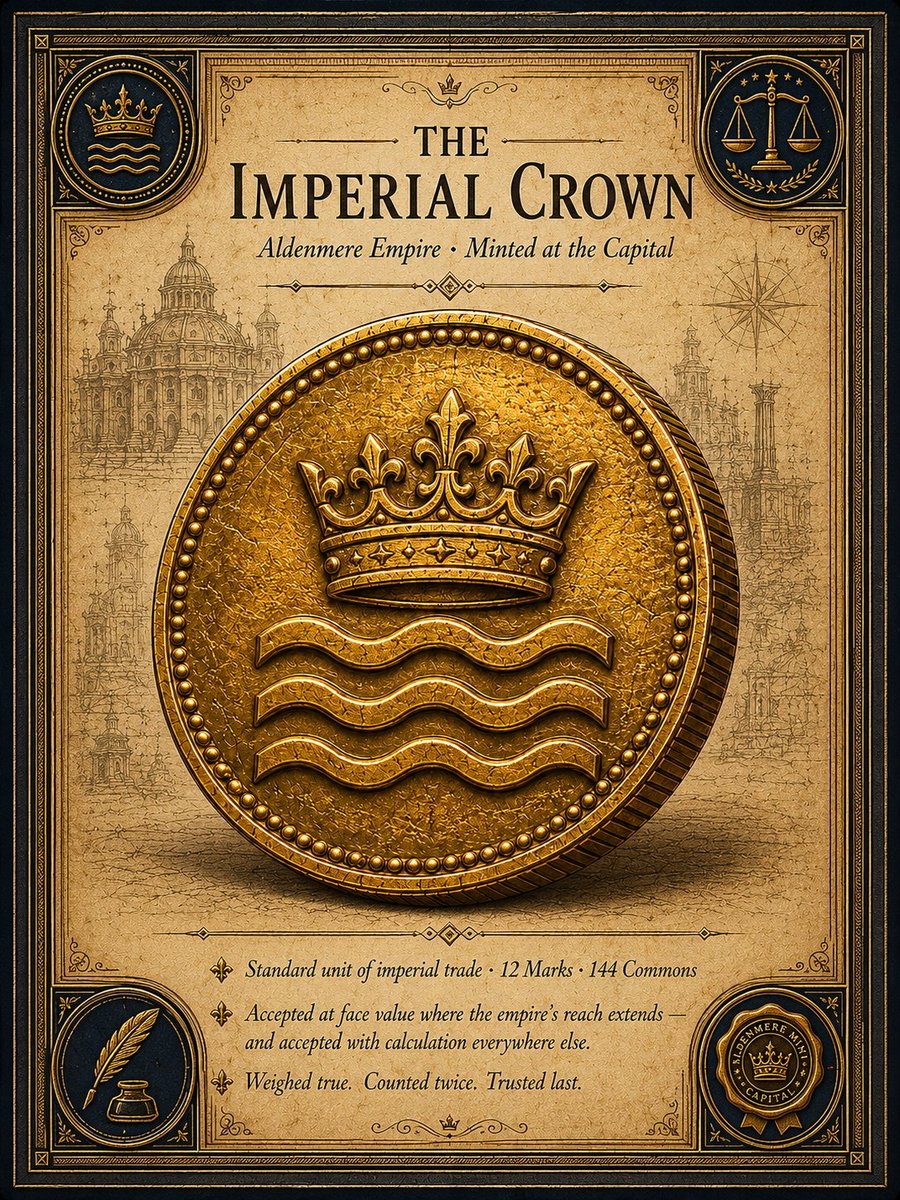
The Imperial Crown
The most trusted coin in three continents. That trust is not free. It was built deliberately, and it costs the empire very little to maintain.
One Crown is the standard unit of imperial trade — nominally equivalent to twelve Marks or one hundred and forty-four Commons. The exchange rate is imperial law, which means it is binding within the empire and a strong suggestion everywhere else.
Anywhere with an imperial customs post. In practice: most of Valdenmoor, major port cities on Thurak's northern coast, and everywhere that aspires to be taken seriously by people who have Crowns. The Crown does not ask to be accepted. It simply is.
I have watched a Crown lose approximately six percent of its value simply by being produced north of the Veld checkpoint. The checkpoint guard did not change the exchange rate. He did not have to. He just took slightly longer to inspect the cargo.— D. Calder, Road-Broker, Valdenmoor
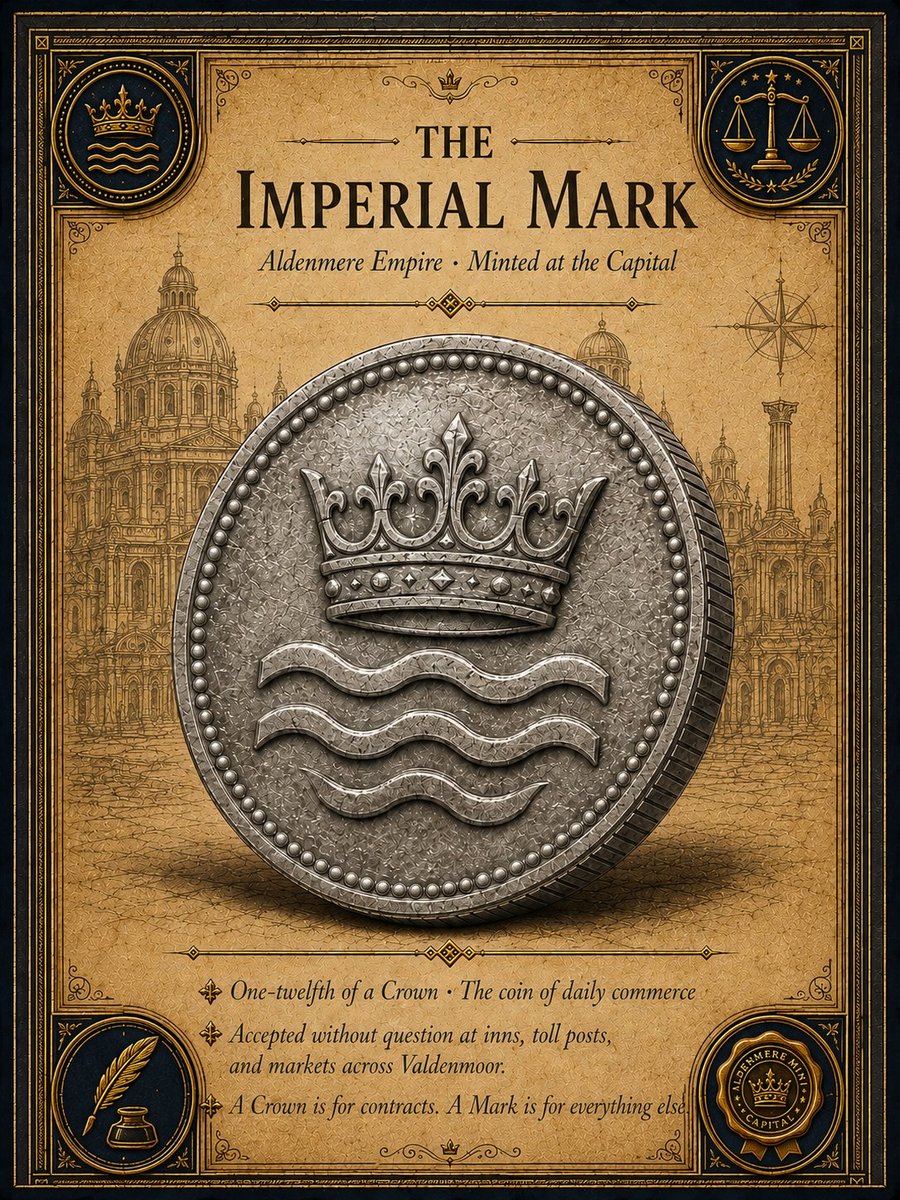
The Imperial Mark
The coin that does most of the actual work. A Crown is for contracts. A Mark is for everything else.
One-twelfth of a Crown. The standard denomination for daily commerce, inn fees, road tolls, and anything too large for Commons and too small for a Crown to be produced without embarrassment.
Universally within the empire. Accepted without question at inns, toll posts, and markets across Valdenmoor. Slightly less enthusiastically received east of the Karath passes, where the stonehall merchants note its silver content with the particular expression dwarves use when they are too polite to say something is insufficient.
Twelve Marks to a Crown is an imperial assertion. The dwarves of Kazgrom will accept twelve Marks in exchange for a Crown only if the Marks weigh correctly and the silver content meets their assay. I carry a small balance for exactly this purpose. The empire considers this insulting. The dwarves consider the empire's feelings about their assay to be the empire's own problem.— D. Calder, Road-Broker, Valdenmoor
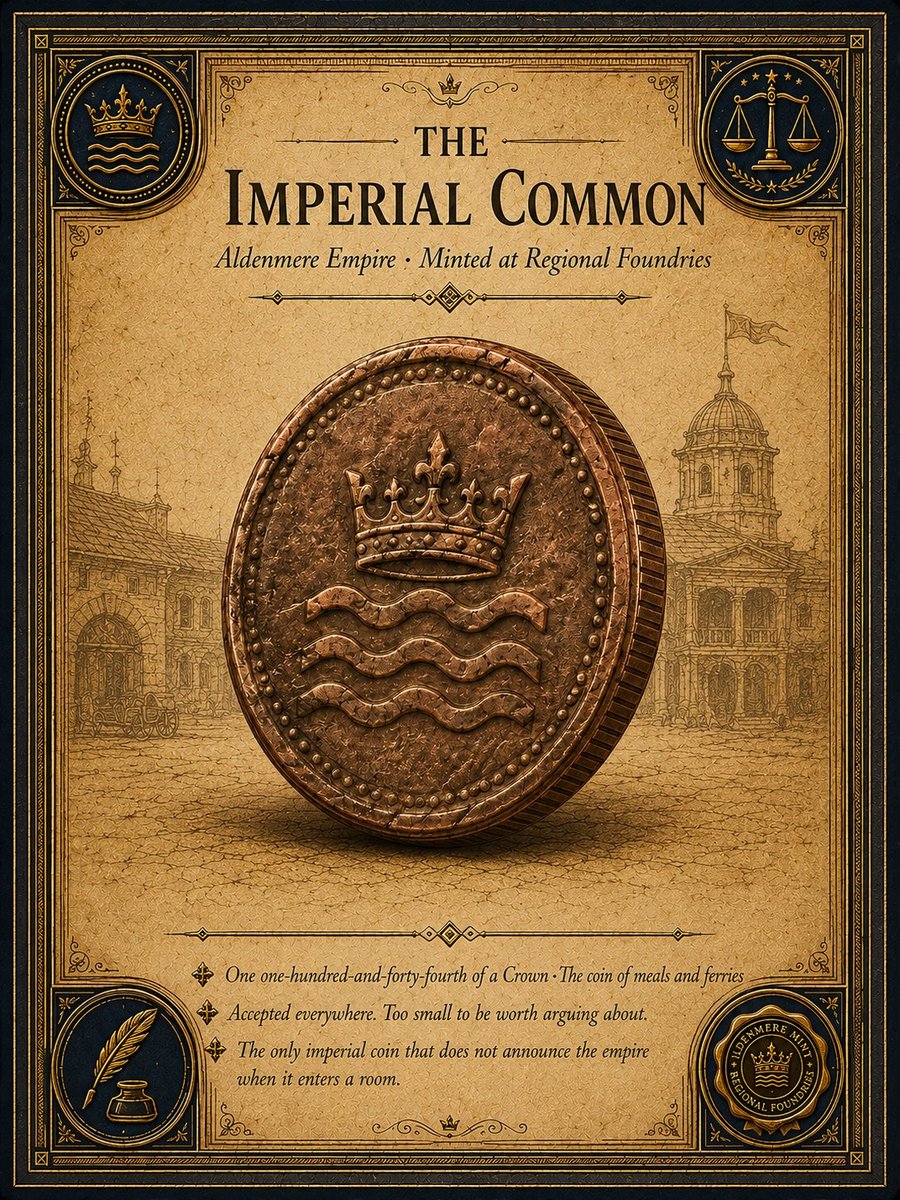
The Imperial Common
The empire at its most honest: a small copper coin that claims nothing except to be worth something small, and generally is.
One one-hundred-and-forty-fourth of a Crown. The coin of meals, ferries, market stalls, and gratuities. The only imperial denomination that is not secretly a political argument.
Everywhere. Commons are accepted in places that would regard a Crown with suspicion and a Mark with calculation. They are too small to be worth arguing about. This is their greatest virtue.
I have entered towns in the northern hill country where the innkeeper would not take a Crown and could not make change for a Mark, but Commons moved through the market without comment. There is a kind of freedom in being worth very little. The Common is the only imperial coin that does not announce the empire when it enters a room.— D. Calder, Road-Broker, Valdenmoor
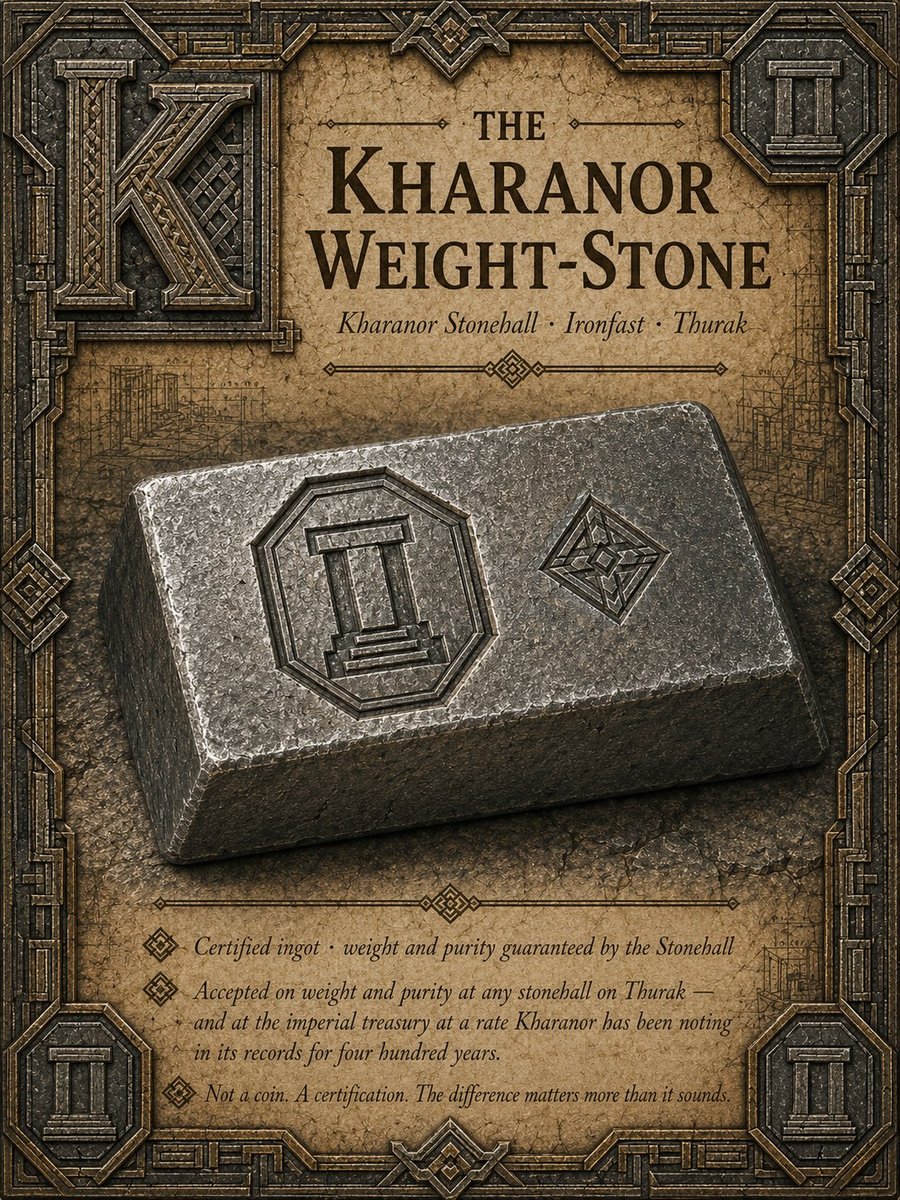
The Kharanor Weight-Stone
Not a coin. A certification. The difference matters more than it sounds.
A certified ingot of standardised weight and verified purity, bearing the Kharanor hall-mark and the notation of the certifying assayer. The Weight-Stone does not have a face value. It has a certified content, and the content is the value.
Accepted on weight and purity at any stonehall on Thurak — and at the imperial treasury at a rate Kharanor has been noting in its records for four hundred years as consistently below fair value. The Kharanor stonehall has continued accepting the imperial rate. They note it. They do not explain why they continue to accept it. Breck has seen the notation in question and said nothing.
Not a coin. A certification. The difference is this: a coin asks to be trusted. A Weight-Stone simply is what it says it is, and if the assay disagrees, the assay is wrong.— B. Ironhallow, Kharanor
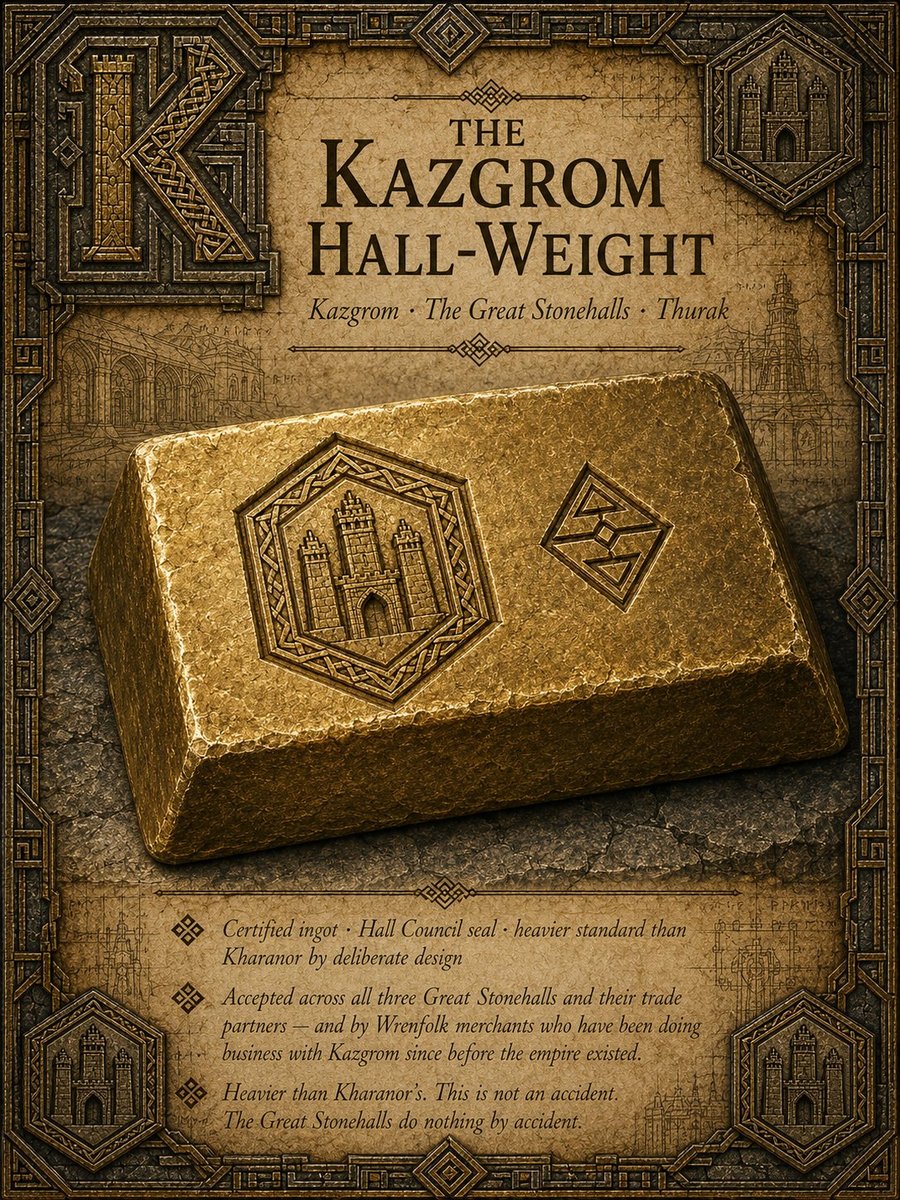
The Kazgrom Hall-Weight
Heavier than Kharanor's. This is not an accident. The Great Stonehalls do nothing by accident.
A certified ingot bearing the Hall Council seal of Kazgrom, the largest of the three great stonehalls. The standard is deliberately heavier than Kharanor's by a margin that Kazgrom has never formally explained and that every dwarven merchant understands immediately.
Accepted across all three Great Stonehalls and their trade partners — and by Wrenfolk merchants who have been doing business with Kazgrom since before the empire existed. The Kazgrom Hall-Weight is the closest thing the dwarven economy has to an imperial Crown, which is to say: not very close, but recognized wherever it matters.
The Hall-Weight is heavier than it needs to be by any practical standard. I asked, once, why Kazgrom sets its weight above the Kharanor standard. The answer was: because Kazgrom sets its weight. That is the complete answer.— D. Calder, Road-Broker, Valdenmoor
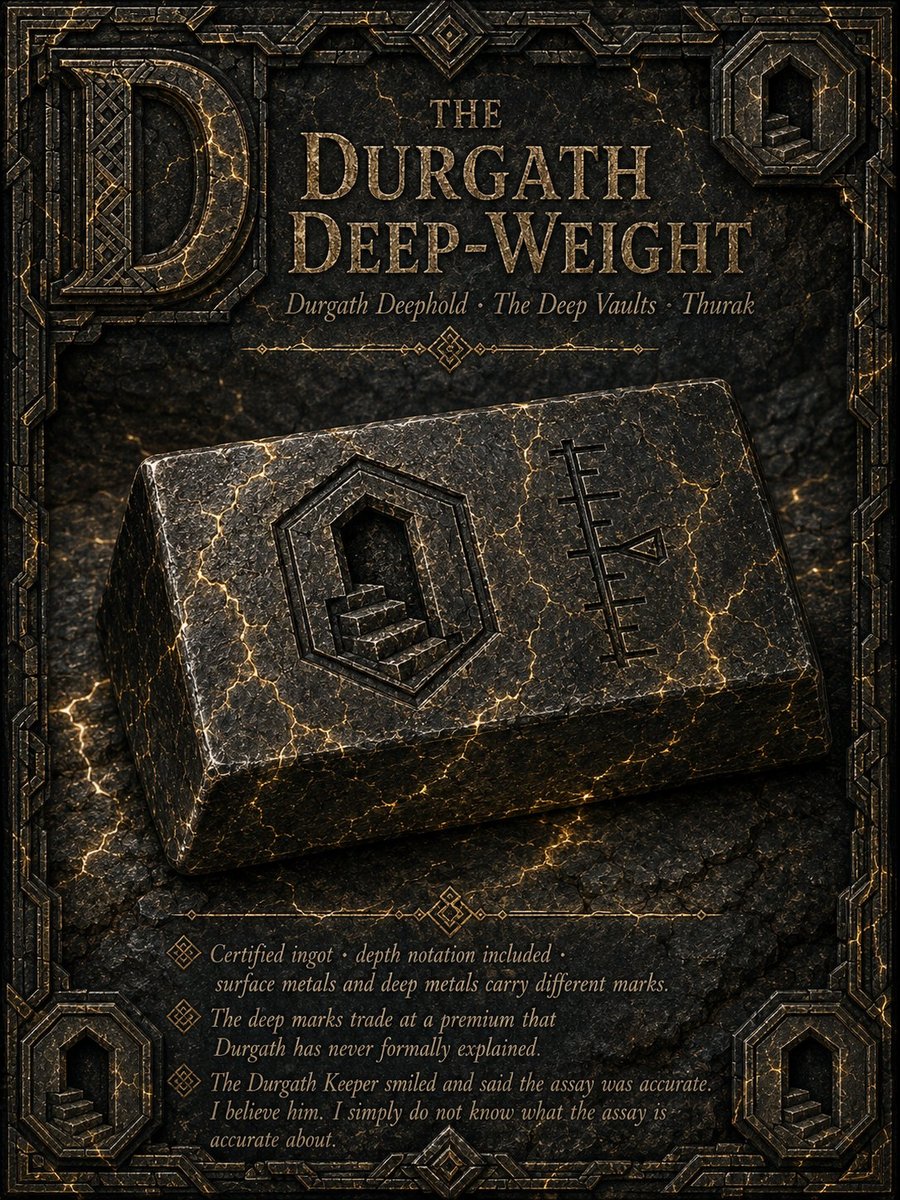
The Durgath Deep-Weight
A certified ingot with a depth notation included. Surface metals and deep metals carry different marks. The deep marks trade at a premium that Durgath has never formally explained.
A certified ingot from Durgath's vaults, with the depth of extraction noted on the face. Surface designation carries the standard Durgath mark. Deep designation carries a secondary mark that the Durgath Keeper describes only as accurate.
Accepted at any stonehall that trades with Durgath. The deep-marked weights command a premium that no one outside Durgath's accounting has successfully explained. The metals are chemically identical by every assay anyone has run. The difference is the notation. The notation is what Durgath says it is.
The Durgath Keeper smiled and said the assay was accurate. I believe him. I simply do not know what the assay is accurate about.— D. Calder, Road-Broker, Valdenmoor
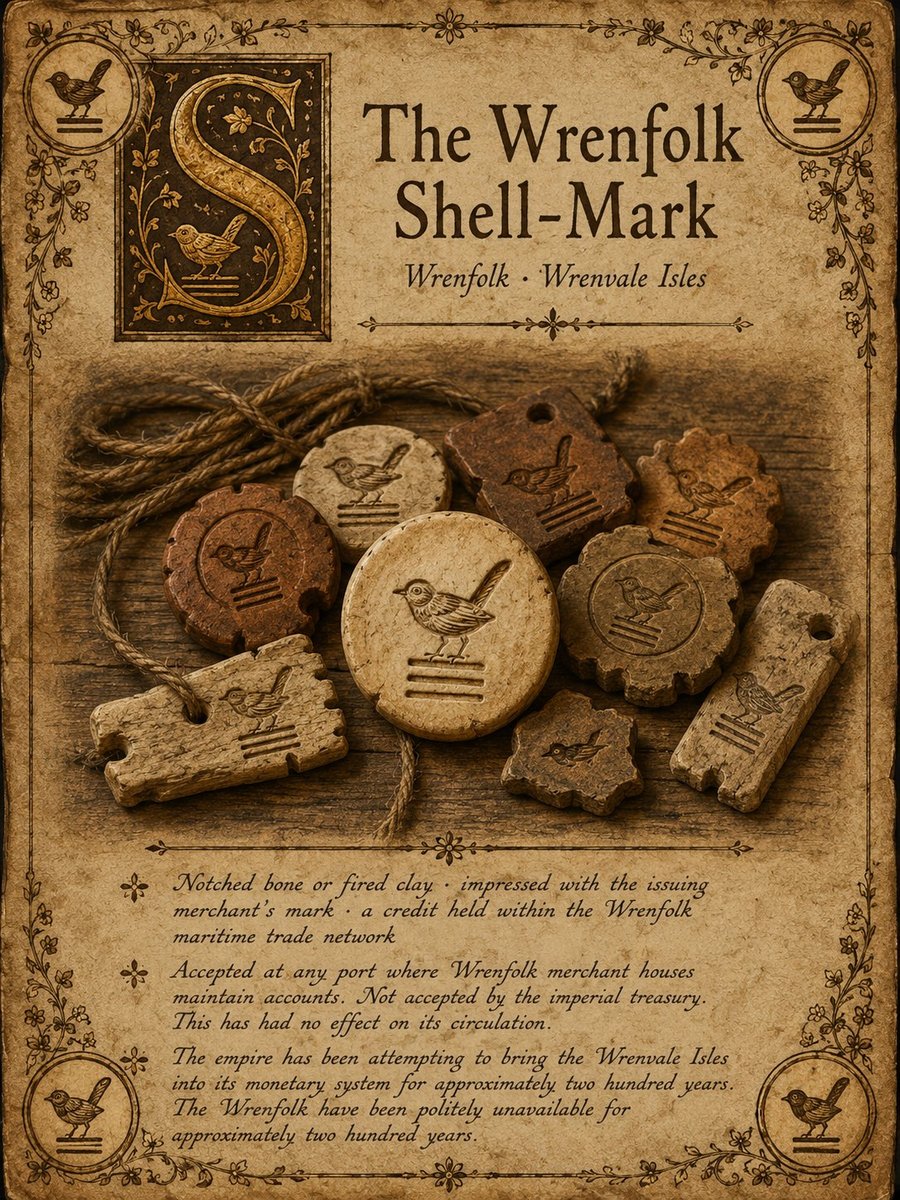
The Wrenfolk Shell-Mark
Older than the Imperial Crown by several centuries. The empire has not officially acknowledged this. The Wrenfolk have not officially cared.
A Shell-Mark is a trade token — notched bone or fired clay impressed with the issuing merchant's mark and a value notation in the Wrenfolk counting system. It represents a credit held within the Wrenfolk maritime trade network. The physical object is worth nothing. The network behind it is worth considerably more.
Accepted at any port where Wrenfolk merchant houses maintain accounts — most of the Valdenmoor coast, the northern Thurak ports, and the island chains between. Not accepted by the imperial treasury. This has had no effect on its circulation.
The empire has been attempting to bring the Wrenvale Isles into its monetary system for approximately two hundred years. The Wrenfolk have been politely unavailable for approximately two hundred years. The Shell-Mark continues to circulate. I respect this deeply.— D. Calder, Road-Broker, Valdenmoor
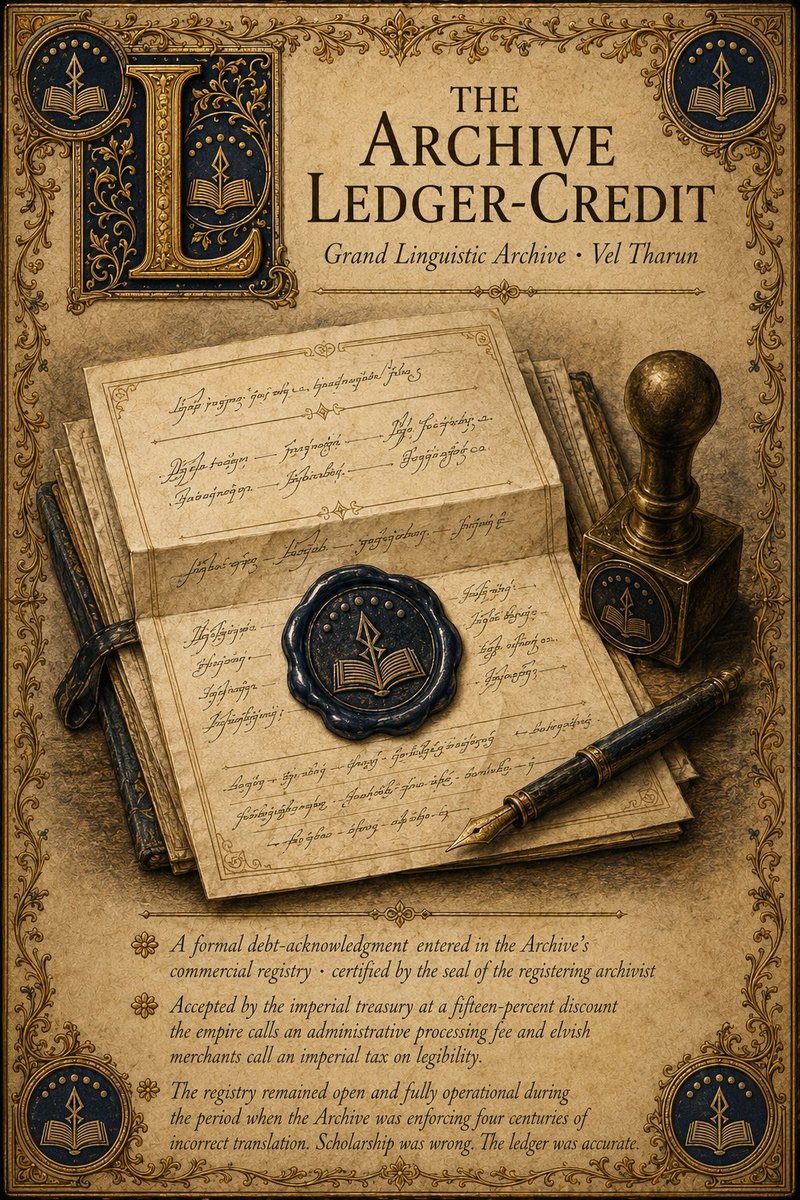
The Archive Ledger-Credit
Not a coin. Not a token. A notation in the Archive's commercial registry, backed by three centuries of elvish institutional reputation.
A formal debt-acknowledgment entered in the Archive's commercial registry and certified by the seal of the registering archivist. It records a named value, creditor, and debtor. The original entry in the registry is the binding instrument. The paper bearing the Archive seal is the proof of that entry.
Accepted anywhere an elvish merchant house maintains a registry relationship — most of Valdenmoor's significant trade cities and the larger Thurak ports. Accepted by the imperial treasury at a fifteen-percent discount the empire calls an administrative processing fee and that elvish merchants call an imperial tax on legibility.
The Archive's registry remained open and fully operational during the period when the Archive was enforcing four centuries of incorrect translation. Scholarship was wrong. The ledger was accurate. I find I do not know what to do with this.— Thessaly Vorn, formerly of Vel Tharun
The Thurak Obligation
There is no coin. There is no token. There is what was given, what is owed, and who witnessed it. The empire calls this barter. The orc clans have a different word for it, and the difference is not small.
The Thurak clans do not use coined or token currency. Exchange is conducted in goods, labor, and witnessed obligation. An obligation is considered a living thing: it exists, it has weight, and it does not diminish by being ignored. It diminishes only when it is met.
Within the Thurak steppes and between clans with established exchange relationships. Not recognized by the imperial treasury. Recognized by certain Wrenfolk maritime merchants, who note in their own records that Thurak obligations have a lower default rate than imperial promissory instruments.
A Thurak Obligation is not barter. Barter is the exchange of one thing for another thing, completed in the moment and finished. A Thurak Obligation is the acknowledgment that something has passed between two people and that the world has noticed. It is witnessed. It persists. I have been carrying one for three years. I do not plan to dishonor it.— M. Ashbone, Thurak Steppes
Every system of currency in this record is built on one thing: the belief that the person on the other side of the transaction will honor what they have offered. The Crown is backed by the empire's willingness to enforce it. The Weight-Stone is backed by the dwarves' willingness to certify it. The Ledger-Credit is backed by the Archive's institutional reputation. The Shell-Mark is backed by the Wrenfolk trade network's memory. The Thurak Obligation is backed by the witness of those present and the character of the parties involved. None of these are the same thing. They are all the same thing. I have been on enough roads to know that the most reliable currency I have ever encountered is the second kind. The first kind requires enforcement. The second kind does not.— D. Calder, Road-Broker, Valdenmoor