Companion Archive

Seals, Marks, and Signs

Full entries from the record compiled by Sable Dunmore, with annotations by Thessaly Vorn, Breck Ironhallow, and archivists of the restored Grand Linguistic Archive.

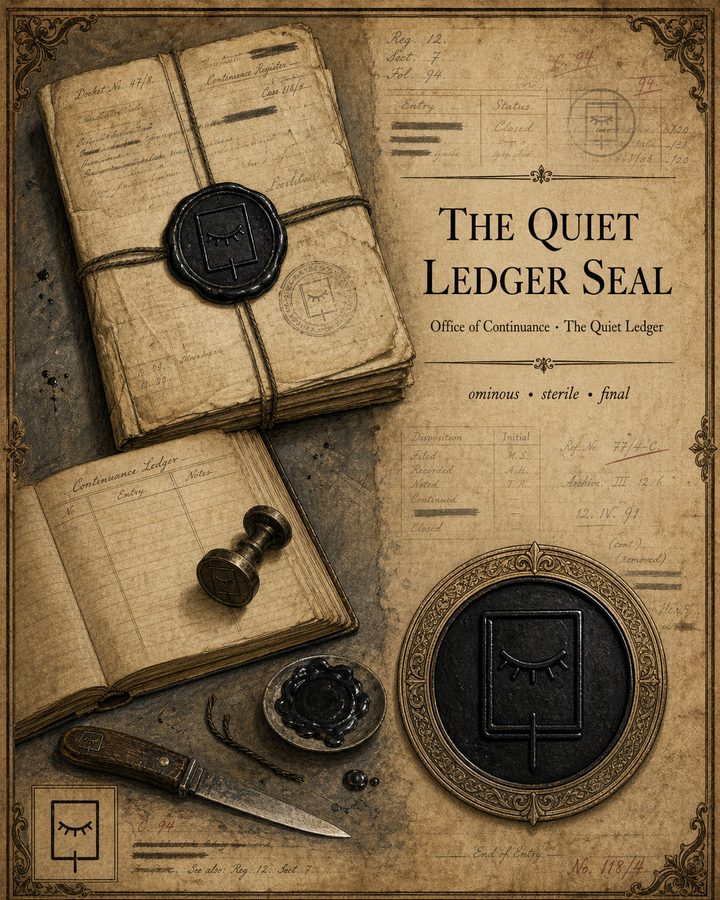
The Quiet Ledger Seal from Songs of the Firstborn — the closed eye of the Office of Continuance
Seal Entry · 1

The Quiet Ledger Seal

Office of Continuance · The Quiet Ledger

The eye is not closed because it cannot see. It is closed because it has chosen not to.


What It Claims to Mean

The closed eye signifies continuance — the orderly management of sensitive records in the interest of imperial stability.

What It Actually Does

It marks the boundary between what the empire has decided you may know and what it has decided you may not. Everything sealed beneath it has been made, officially, to not exist.

Where It Appears

Confiscation notices. Sealed archive sections. Redacted records. Imperial continuance orders. Documents that have no official existence and therefore cannot be appealed.

I saw this seal before I understood it. The wax was black. The eye was closed. I thought it was simply a filing mark — some administrative shorthand I hadn't encountered in Ashfen. It took me longer than I would like to admit to understand that the eye is not closed because it cannot see. It is closed because it has chosen not to. There is a difference. I have spent considerable effort since then learning to recognize that difference in other contexts.— S. Dunmore, Keeper of Records, Ashfen
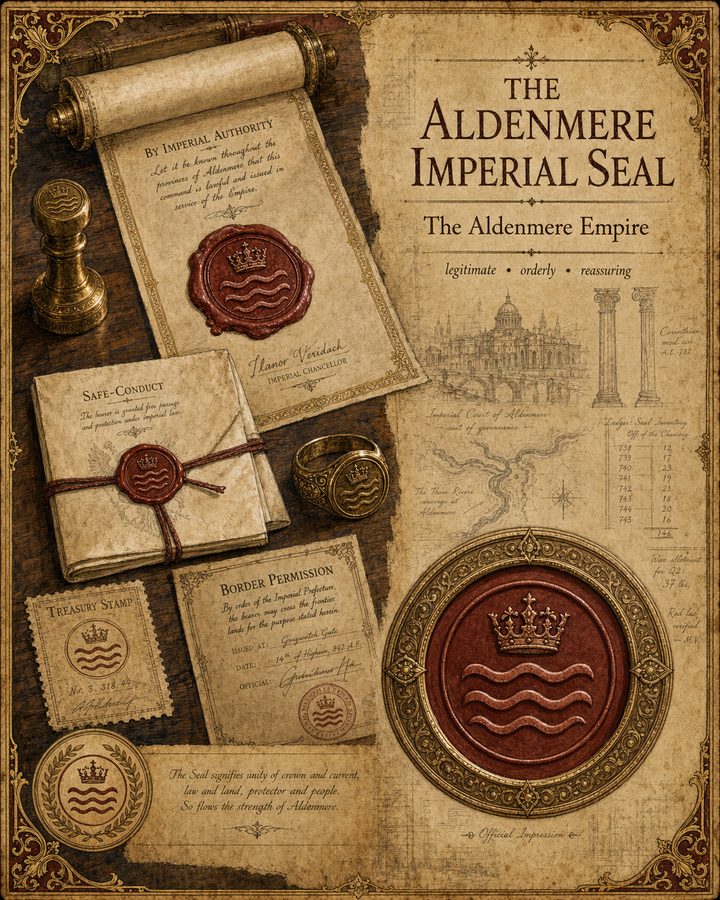
The Aldenmere Imperial Seal from Songs of the Firstborn — the mark of the empire that authorizes and suppresses
Seal Entry · 2

The Aldenmere Imperial Seal

The Aldenmere Empire

It looks entirely trustworthy. That is not an accident of design.


What It Claims to Mean

The crown and three rivers signify the unity of governance and land — the empire as caretaker of its people, its authority flowing from the confluence of the three rivers at the capital.

What It Actually Does

It authorizes. Whatever bears this seal is legitimate by definition. Its danger is not in how it looks — it looks entirely trustworthy — but in the fact that it cannot distinguish between a good order and a harmful one. It authorizes both with equal weight.

Where It Appears

Public laws. Treasury documents. Military orders. Safe-conducts. Border permissions. Imperial tax records. Proclamations issued in the name of continuity.

Ordinary people trust this seal, and they are not wrong to. Most of what it appears on is exactly what it claims to be. The difficulty is that most is not all, and the seal itself makes no distinction. I have handled hundreds of imperial documents. The ones that did the most damage looked identical to the ones that did no damage at all. That is not an accident of design.— S. Dunmore, Keeper of Records, Ashfen
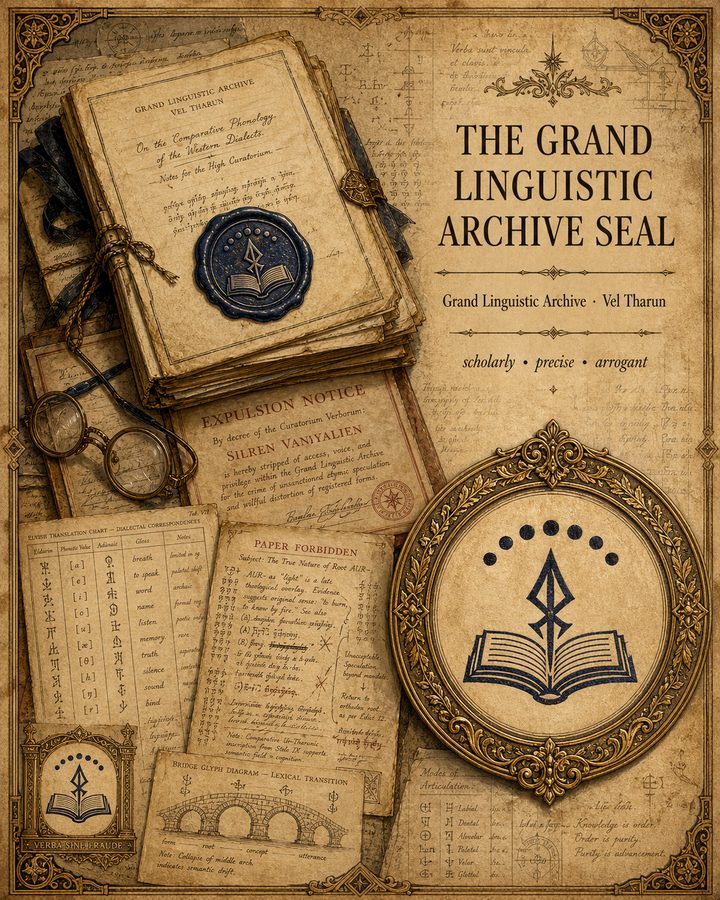
The Grand Linguistic Archive Seal from Songs of the Firstborn — the institutional mark of the nine-hundred-year elvish archive at Vel Tharun
Seal Entry · 3

Grand Linguistic Archive Seal

Grand Linguistic Archive · Vel Tharun

It owns knowledge — with the same confidence it appears on everything else.


What It Claims to Mean

The open book and seven marks signify knowledge preserved under scholarly authority. The seven marks reference the bridge glyphs connecting Proto-Veranthi and Vel-Drath — the Archive's founding achievement.

What It Actually Does

It owns knowledge. It determines what scholarship is permitted, what translation is licensed, and who may be removed from the field of inquiry when their findings become inconvenient. The seven bridge glyphs it references were misidentified for four centuries. The seal appeared on the papers enforcing that misidentification with the same confidence it appears on everything else.

Where It Appears

Scholarly correspondence. Translation licenses. Expulsion notices. Banned papers. Restricted shelf markers. Access permissions that are easier to revoke than to grant.

My expulsion notice bore this seal. I have looked at it many times. The mark is genuinely beautiful — precise, elegant, exactly the thing it claims to be. I hated that. I still do, a little. A seal that looked like what it was would have been easier to argue with.— Thessaly Vorn, Vel Tharun
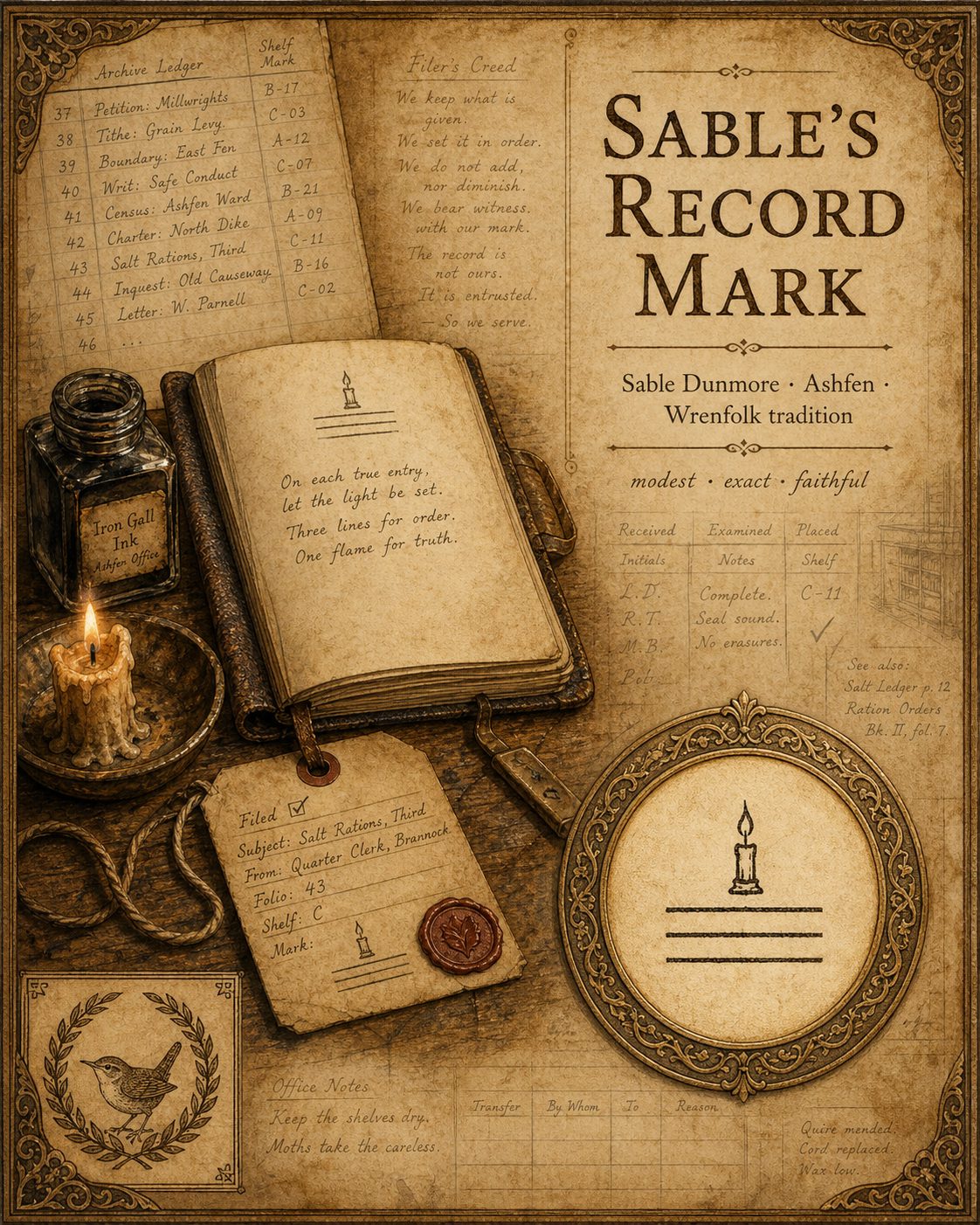
Sable Dunmore's record mark from Songs of the Firstborn — a Wrenfolk filing stamp meaning a record kept is a candle lit
Seal Entry · 4

Sable's Record Mark

Sable Dunmore · Ashfen · Wrenfolk tradition

A record kept is a candle lit. It claims exactly what it does — which makes it unusual in this collection.


What It Claims to Mean

A record kept is a candle lit. The mark indicates a completed, verified entry made in good faith — neither added to nor diminished.

What It Actually Does

Exactly what it claims. I am aware this makes it unusual in this collection.

Where It Appears

Personal notebooks. Ashfen filing tags. Completed official records. Later editions of the Dunmore Record. Any entry I have made and stand behind.

Thessaly insisted this belong here alongside imperial seals and archive marks. I objected on the grounds that a filing stamp used by a records-keeper in a market town is not in the same category as the institutional apparatus of a continental empire. She said that was precisely why it belonged here. I have included it. I remain uncertain she is right, and reasonably confident she is.— S. Dunmore, Keeper of Records, Ashfen
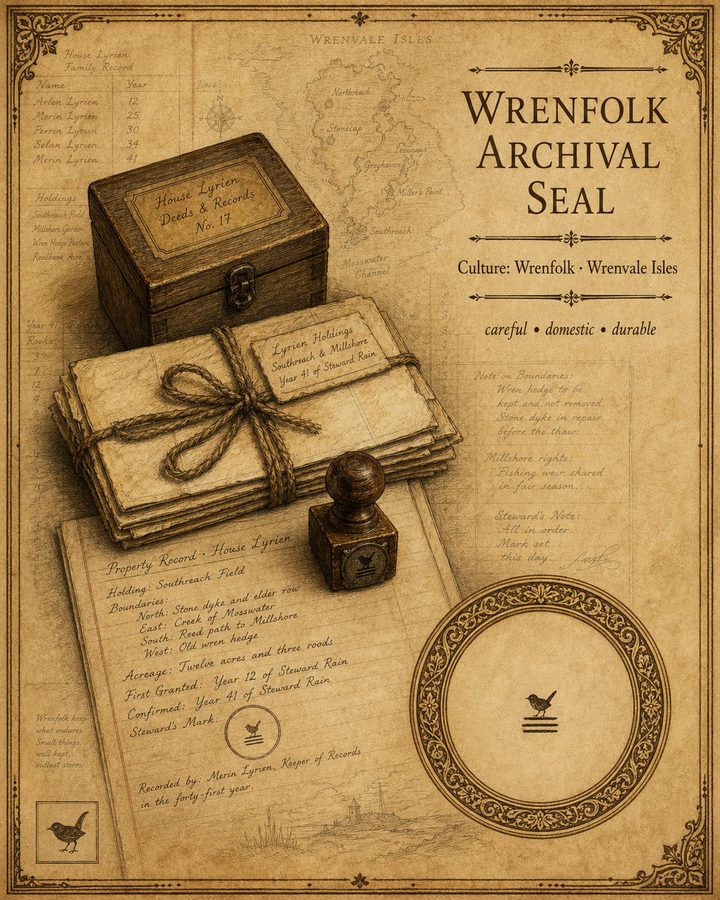
The Wrenfolk Archival Seal from Songs of the Firstborn — the mark of Wrenvale Islands record-keeping tradition
Seal Entry · 5

Wrenfolk Archival Seal

Wrenfolk · Wrenvale Isles

They do not make their mark impressive. They make it accurate.


What It Claims to Mean

A Wrenfolk-verified record — property, family, boundary — kept carefully and intended to last.

What It Actually Does

Preserves the things the world is not watching carefully enough to notice it is losing. The Wrenvale filing tradition predates the Grand Linguistic Archive by several centuries and has, in the records examined, a lower error rate.

Where It Appears

Family papers. Property records. Island legal documents. Boundary agreements. Old correspondence from the Isles. Records of things that seemed small at the time.

The Wrenfolk do not make their mark impressive. They make it accurate. I spent thirty years in Merrath teaching basic elvish grammar to merchants' children, and in that time I examined more Wrenfolk property records than Archive-certified documents. The Wrenfolk records were more reliable. I find I am still slightly annoyed by this, for reasons that reflect poorly on my training.— Thessaly Vorn, Vel Tharun
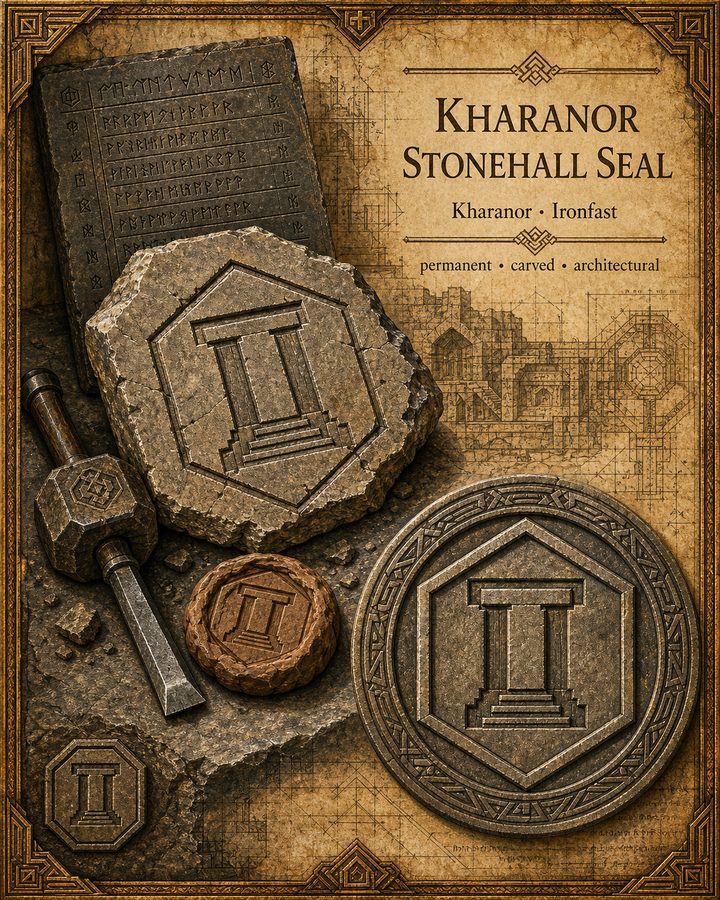
The Kharanor Stonehall Seal from Songs of the Firstborn — dwarven memory cut rather than written
Seal Entry · 6

Kharanor Stonehall Seal

Kharanor · Ironfast · Thurak

Dwarven memory cut rather than written — final rather than provisional.


What It Claims to Mean

The mountain gate signifies permanence — dwarven memory as something cut rather than written, final rather than provisional.

What It Actually Does

Certifies that a record has been committed to stone and cannot be amended — only supplemented. In Kharanor, a sealed record is considered closed. What happened in Year 728 CE tested that principle in ways the stonehall had no precedent for.

Where It Appears

Stone archive records. Vault permissions. Lineage tablets. Deep-record markers. The record of the Vel-Kel's recovery, which now occupies a section of the Kharanor deep archive that required new stone.

Kharanor's deep record had been kept without interruption for eleven generations. The Keeper of that record in Year 728 had suppressed one entry for most of his tenure. The seal's authority held regardless. The dwarves of Kharanor do not discuss this. They cut a new section and continued.— Archivist, restored Grand Linguistic Archive, ~735 CE
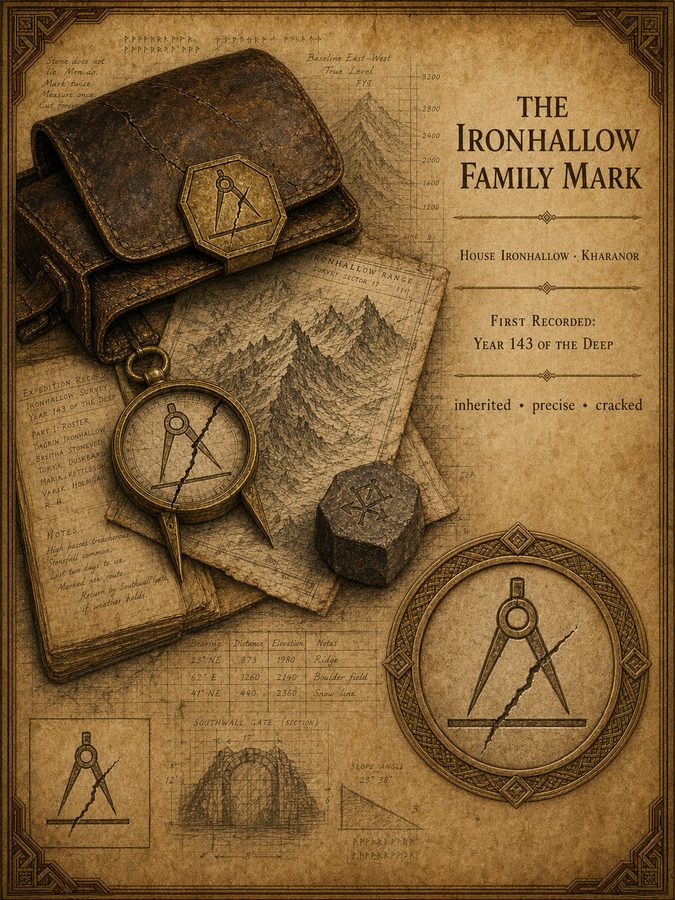
The Ironhallow Family Mark from Songs of the Firstborn — the dwarven surveying seal bearing a crack added after Year 143 of the Deep
Seal Entry · 7

The Ironhallow Family Mark

House Ironhallow · Kharanor · Thurak

The crack was added after Year 143 of the Deep and has appeared in every version since. The family has never officially explained why.


What It Claims to Mean

The surveying compass signifies precision — the Ironhallow tradition of exact measurement and cartographic record going back to the founding of the deep surveys.

What It Actually Does

Carries the weight of what was measured and what was not understood. The crack was added to the mark after Year 143 of the Deep and has appeared in every version since. The family has never officially explained why.

Where It Appears

Survey records. Map cases. Family tools. The record of the Year 143 expedition. A compass carried by Breck Ironhallow from Valdenmoor to Vel Andurath and back.

The Year 143 expedition record is held in Kharanor's deep archive. Six names on the roster. The sixth is listed only as initials. The notes read: high passes treacherous, stonefall common, marked new route, return by Southwall Gate if weather holds. The survey they produced was accurate. What they found in the lower passage is recorded in a supplementary section that was sealed for two hundred years and opened, at Breck Ironhallow's request, in Year 729.— Archivist, restored Grand Linguistic Archive, ~735 CE
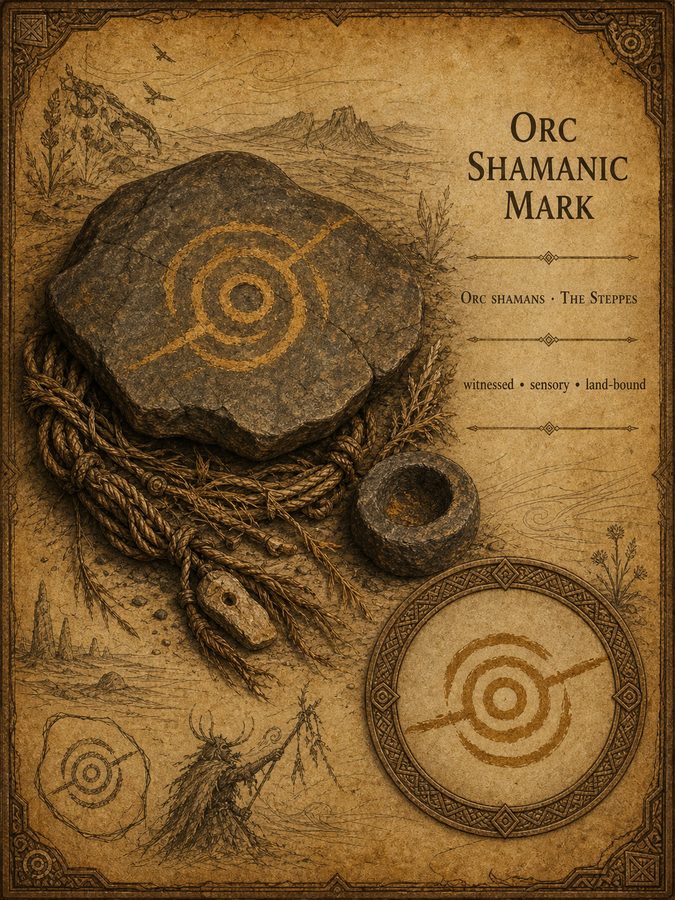
Orc shamanic mark from Songs of the Firstborn — a witness mark from the Thurak steppes that records what the land felt
Seal Entry · 8

Orc Shamanic Mark

Orc Shamans · The Steppes · Thurak

It does not claim authority. It witnesses.


What It Claims to Mean

The shamanic mark does not claim anything. It witnesses. It records what the land felt at a specific place and time, made because the place required acknowledgment, not because anyone required ownership of the record.

What It Actually Does

The same. This is one of only two entries in this collection — alongside the Drevari marks — where the claimed meaning and the actual meaning are identical.

Where It Appears

Fieldstones and boundary markers on the steppes. Memory bundles. Ritual sites. Places where the land's grief has been formally acknowledged. Mara Ashbone's personal objects.

The orc shamans of the Thurak steppes had been recording the void's approach for eleven years before the first imperial archive noted any anomaly. Their marks appeared on stones in places that later proved to be directly above stone network nodes. They did not know what a stone network was. They knew what the land was feeling. The distinction between those two kinds of knowledge is something the restored Archive is still working out how to account for.— Archivist, restored Grand Linguistic Archive, ~735 CE
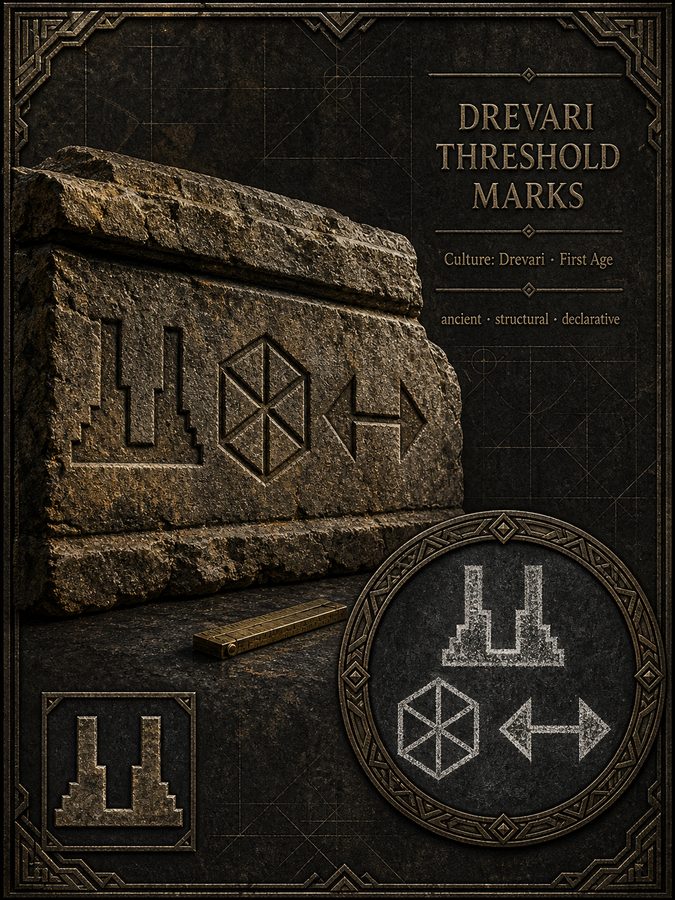
Drevari threshold marks from Songs of the Firstborn — ancient First Age symbols that describe what is true rather than what is owned
Seal Entry · 9

Drevari Threshold Marks

Drevari · First Age

Not symbols. Descriptions. A mark that states what is true rather than what is owned.


What It Claims to Mean

Drevari marks do not claim anything. A threshold mark means: this is a threshold. A load-bearing mark means: this stone bears weight. They are not symbols. They are descriptions.

What It Actually Does

Exactly what they say. The distinction between a mark that claims authority and a mark that states reality is the central epistemological argument of Vel-Drath, and it took thirty years in exile to understand why that distinction is not academic.

Where It Appears

Ruin entrances. Stone doors. Chamber thresholds. Load-bearing keystones. Anywhere the Drevari needed to record what a thing was, rather than who owned it.

Every other mark in this collection is made by a younger race. You can tell, once you know what you are looking at. The younger races use marks to claim — authority, ownership, knowledge, permanence. The Drevari use marks to say what is true. I do not present this as a judgment. I present it as an observation that took me, a linguist with three centuries of training, an embarrassingly long time to make.— Thessaly Vorn, Vel Tharun
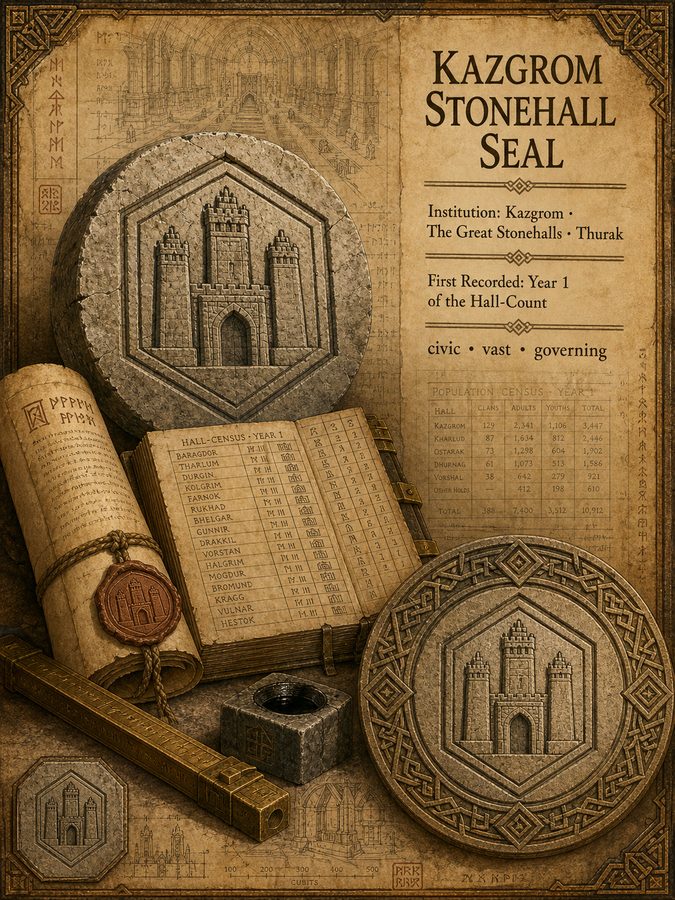
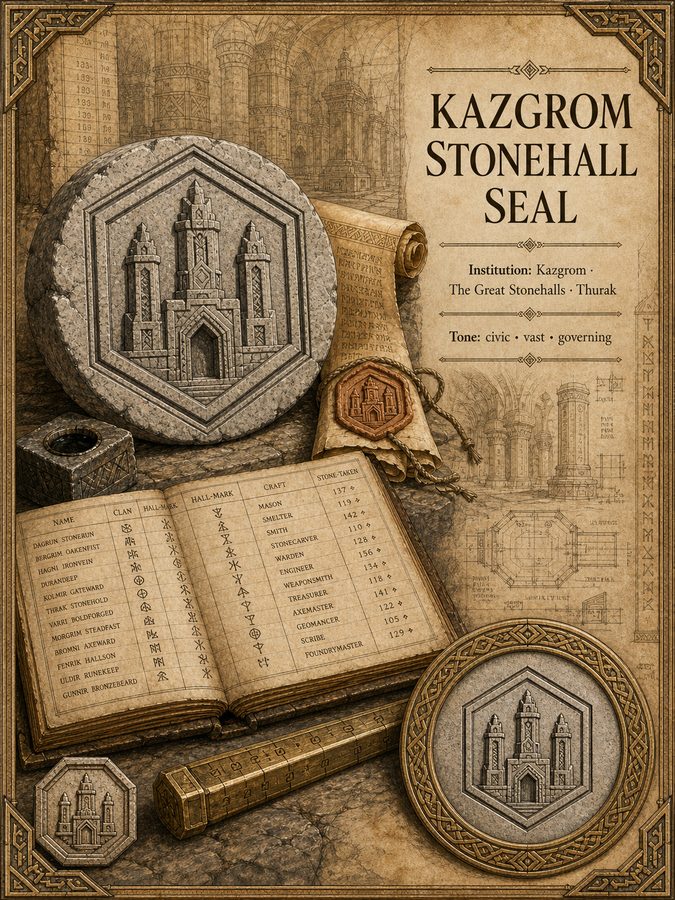
The Kazgrom Stonehall Seal from Songs of the Firstborn — the largest dwarven authority on either continent Kazgrom Stonehall Seal variant from Songs of the Firstborn
Seal Entry · 10

Kazgrom Stonehall Seal

Kazgrom · The Great Stonehalls · Thurak

The largest dwarven authority on either continent. The record speaks and the people let it.


What It Claims to Mean

The three-tower gateway signifies Kazgrom's founding halls — the largest stonehall on Thurak, seat of the Great Hall Council since Year 1 of the Hall-Count.

What It Actually Does

Governs. Every civic decision made across the three stonehalls carries this mark or defers to something that does. It is the largest dwarven authority on either continent and it knows it.

Where It Appears

Civic proclamations. Census records. Hall-marks and craft designations. Inter-stonehall agreements. Any document that needs to remind you how large Kazgrom is.

I left Kharanor at one hundred and eighteen. Kazgrom was the first stonehall I passed through on the way out, and the first I came back to in Year 728. The seal was on the gate record both times. The gate warden who logged me out sixty years ago was retired. The one who logged me back in checked the old entry without being asked. Neither of us said anything about it. That is a Kazgrom thing — the record speaks and the people let it.— B. Ironhallow, Kharanor
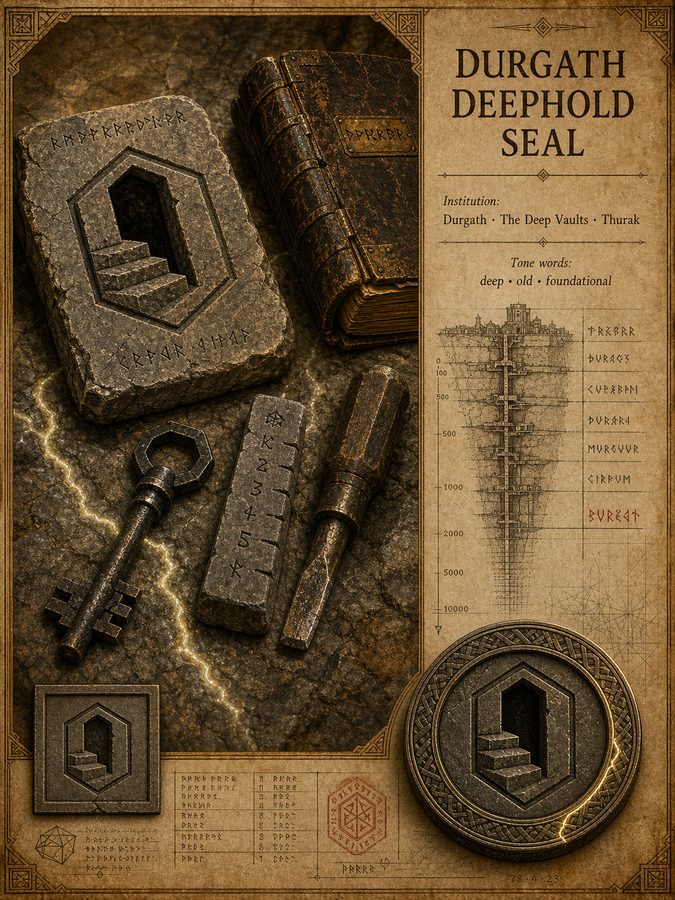
The Durgath Deephold Seal from Songs of the Firstborn — the dwarven mark certifying depth down to where the survey stops
Seal Entry · 11

Durgath Deephold Seal

Durgath · The Deep Vaults · Thurak

It certifies depth down to the point where the survey stops. What lies beneath that point is not acknowledged.


What It Claims to Mean

The descending stair signifies depth — Durgath's authority over the deep vaults and everything recorded within them. The mark appears on every level of the Deephold, down to the lowest surveyed chamber.

What It Actually Does

Certifies depth records down to the point where the dwarven survey stops. What lies beneath that point is not certified. It is not, officially, acknowledged.

Where It Appears

Deep vault records. Depth surveys. Lower-level access permissions. The vertical cross-section maps that show six named levels and an arrow pointing further down with nothing after it.

In Year 728, when the network fired, the deepest level of Durgath lit up along a vein that no dwarven survey had mapped. The current Keeper has opened a new section in the deep record. The heading reads: Prior Occupancy. It is the first entry in Durgath's archive that predates the Hall-Count.— B. Ironhallow, Kharanor